Cognitive classification using MRI and blood biomarkers
Abstract
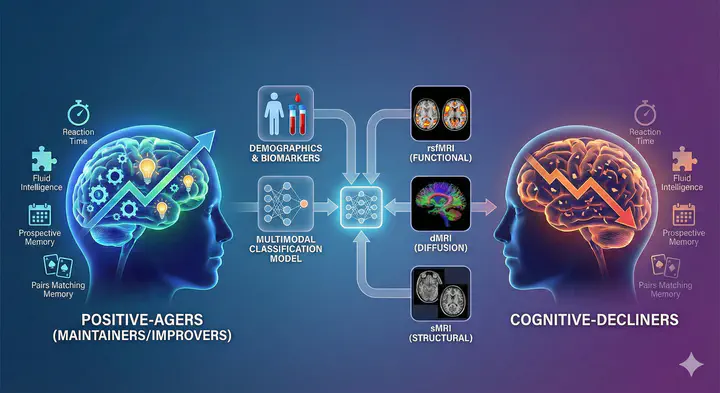
Elderly individuals often encounter cognitive decline as a natural aspect of the aging process. However, there are some individuals who maintain (i.e., Cognitive-Maintainers) or improve cognitive performance as they age (i.e., Positive-Agers). Distinguishing between Positive-Agers and Cognitive-Decliners is the first step toward understanding the factors that protect against or prevent cognitive decline and contribute to successful aging. This research study involved 1,665 participants aged 65 and above from the UK Biobank. We grouped the participants into Positive-Agers and Cognitive-Decliners based on four cognitive function tests: Reaction Time (RT), Fluid Intelligence (FI), Prospective Memory (PM), and Pairs Matching Memory (PMM). To classify Participants into one of these groups, we incorporated 942 features comprising of demographic information, blood biomarkers, and multiple MRI sources, including Resting-State Functional Magnetic Resonance Imaging (rsfMRI), Diffusion Magnetic Resonance Imaging (dMRI), and Structural Magnetic Resonance Imaging (sMRI). This study introduces the optimal subset of features that are helpful in accurately identifying cognitive groups.

Mohammad Fili
Postdoctoral Research Fellow
My research interests include Healthcare Data Analytics, Machine Learning, and Optimization.