Regional demand forecasting using clearance deals data for an online retailer company
Abstract
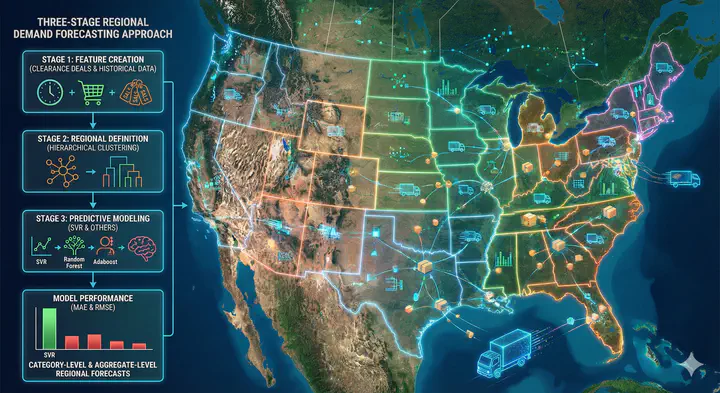
One of the significant sources of cost for online retailers, especially those selling goods in large quantities is operation and logistics. Logsitics planning and optimization are essential in such businesses as the orders must be delivered to customers and this requires accurate transportation planning. Accurate demand forecasting and transportation planning are paramount for e-commerce firms offering clearance deals, as these products can greatly increase sales and demand, but can be a complex task due to the vastness of the covered area. Moreover, since customer behavior and demand may vary in different locations of the covered area, it may be a good idea to develop a more nuanced approach for logistics planning by dividing the area into sub-regions and conducting regional demand forecasting. In this study, we proposed a three-stage approach for regional demand forecasting that includes 1) creating a comprehensive set of features using clearance deals and short-term historical data, 2) defining the regions using hierarchical clustering algorithm, and 3) applying various predictive models to forecast future demands. We used the data for an online retailer company that had transactional information and the clearance deals data. As a results we observed that, in terms of MAE and RMSE metrics, Support Vector Regressor (SVR) outperformed all other models in both category-level and aggregate-level for different regions.

Mohammad Fili
Postdoctoral Research Fellow
My research interests include Healthcare Data Analytics, Machine Learning, and Optimization.