Exploring the association between changes in neural connectivity and cognitive function in older adults: A UK Biobank study
Abstract
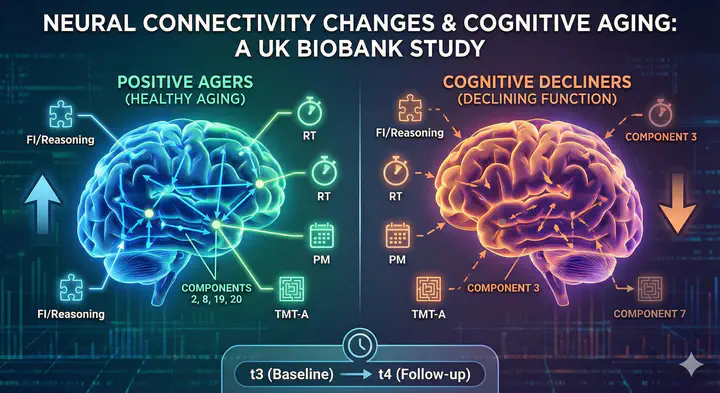
This study investigates the relationship between changes in cognitive performance and alterations in neural connectivity in older adults. We used a cohort of healthy older adults aged 55 years and above enrolled in UK Biobank (N=750). Cognitive classes were defined by categorizing participants into cognitive decliners and positive agers based on cognitive score changes between their third (t_3) and fourth (t_4) follow-up visits. Cognitive performance was assessed across multiple domains including fluid intelligence (FI), reaction time (RT), prospective memory (PM), and the first segment of trail-making test (TMT-A). For the neural connectivity changes, we used resting state functional magnetic resonance imaging (rsfMRI) analyzed across 21 neural components (Components). Significant associations were identified between neural connectivity changes and cognitive performance changes. Reasoning (i.e., FI) was strongly related to Components 2, 8, and 19. Executive function (i.e., TMT-A) showed associations with Components 2, 8, and 20. Meanwhile, PM and RT were associated respectively with Component 3 and Component 7.

Mohammad Fili
Postdoctoral Research Fellow
My research interests include Healthcare Data Analytics, Machine Learning, and Optimization.