Adiposity and insulin resistance moderate the links between neuroelectrophysiology and working and episodic memory functions in young adult males but not females
Abstract
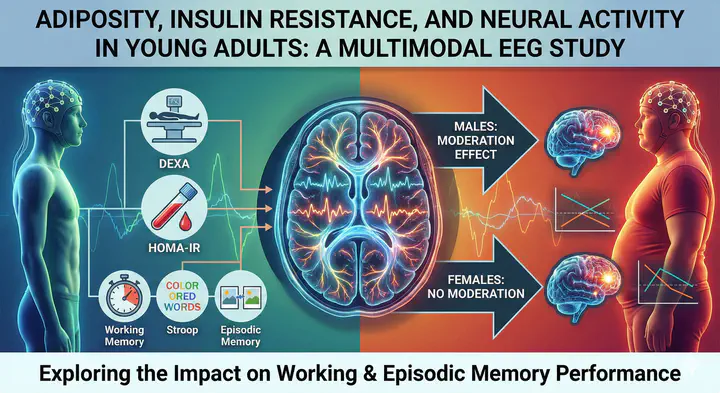
Obesity and insulin resistance may negatively influence neural activity and cognitive function, but electrophysiological mechanisms underlying these interrelationships remain unclear. This study investigated whether adiposity and insulin resistance moderated neural activity and underlying cognitive functions in young adults. Real-time electroencephalography (EEG) was recorded in 38 lean (n=12) and obese (n=26) young adults with (n=15) and without (n=23) insulin resistance (18-38 years, 55.3% female) as participants completed three neurocognitive tasks in working memory (Operation Span), inhibitory control (Stroop), and episodic memory (Visual Association Test). Body fat percentage was quantified by dual-energy X-ray absorptiometry scan (DEXA/DXA). Fasting serum insulin and glucose were quantified to calculate Homeostatic Model Assessment for Insulin Resistance (HOMA-IR) values. In males, body fat percentage and insulin resistance moderate the relationships between greater neural amplitudes and better working memory accuracy. In males, body fat percentage and insulin resistance moderate the relationships between greater frontal neural amplitude and better episodic memory accuracy. Body fat percentage and insulin resistance does not moderate the association between neural activity and memory performance in females.

Mohammad Fili
Postdoctoral Research Fellow
My research interests include Healthcare Data Analytics, Machine Learning, and Optimization.